Introduction
This whitepaper summarizes a three-week research initiative by interns from BCRV Tech-Voc Inc. in Calapan City, Oriental Mindoro. The project evaluated practical, open-source AI integration across the entire Software Development Lifecycle (SDLC) including planning, architecture, coding, testing, documentation, observability, and Retrieval-Augmented Generation (RAG).
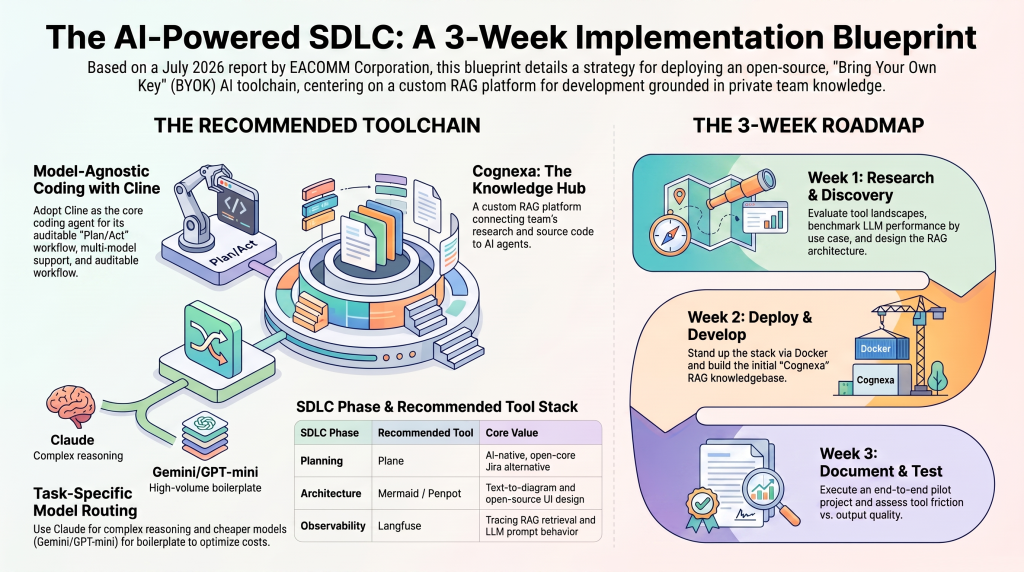
Combining technical research with hands-on deployment, the team developed Cognexa, a model-agnostic AI platform that integrates knowledge management directly into software engineering workflows. This paper provides actionable guidance for teams seeking to build a flexible, secure, and sustainable AI-driven SDLC.
Written By:
Vincent B. Acha
Reymel R. Mislang
Harlyn P. Nebreja
Daryll C. Tupaz
Jenilyn W. Zauld
The AI-Assisted Software Development Lifecycle
How integrating AI across planning, architecture, coding, testing, and operations transforms software engineering into an intelligent, connected ecosystem.
Artificial Intelligence is reshaping the way software is planned, designed, built, tested, documented, and maintained. While much of the conversation has focused on AI coding assistants, today’s most successful development teams recognize that AI delivers its greatest value when integrated across the entire Software Development Lifecycle (SDLC).
Instead of treating AI as a tool that simply writes code, organizations are beginning to adopt AI throughout project management, architecture, quality assurance, documentation, knowledge management, and operations. This broader approach enables teams to deliver higher-quality software faster while reducing repetitive work and improving collaboration.
Interactive SDLC Phase Explorer
Select any lifecycle phase below to see how AI expands beyond simple code completion to support end-to-end engineering tasks:
There Is No Universal Best AI Model
Many organizations ask whether Claude, GPT, Gemini, or open-source models are the “best” choice. The reality is more nuanced: different AI models excel in different situations.
Claude
Architecture & DesignConsistently produces outstanding architecture recommendations, design reasoning, system documentation, and deep code reviews.
Google Gemini
Multimodal & ContextDemonstrates excellent multimodal processing capabilities, strong reasoning performance, and industry-leading large-context windows.
GPT Models
Scripting & WorkflowsPerforms particularly well for scripting, automation workflows, command-line operations, and general developer productivity.
Small / Local LLMs
Cost Efficiency & PrivacyHandles high-volume, repetitive development tasks locally at significantly lower operational costs with strict data privacy.
Why Retrieval-Augmented Generation Is Essential
Traditional LLMs answer questions using static training data. They lack access to an organization’s private repositories, internal procedures, and project history. Retrieval-Augmented Generation (RAG) bridges this gap by grounding AI responses in real-time internal data.
Interactive RAG Pipeline Explorer
Click through each stage to explore how internal knowledge is indexed and delivered to developers accurately:
Why Open Source AI Matters
Open Source AI enables organizations to retain ownership of infrastructure, keep sensitive code within corporate boundaries, avoid vendor lock-in, and swap components as technology evolves.
Plane
ManagementAI-assisted project management and backlog tracking.
Cline
Coding AgentHuman-in-the-loop AI coding agent requiring explicit approval before code/file execution.
Penpot & Mermaid
Design & ArchitectureOpen interface design and dynamic diagram-as-code modeling.
Playwright
TestingAutomated browser testing and end-to-end quality assurance integration.
ChromaDB & LlamaIndex
Vector / RAGVector storage and knowledge orchestration layer for semantic retrieval.
Langfuse & SigNoz
ObservabilityAI prompt tracking, latency monitoring, and operational telemetry.
Introducing Cognexa
The primary outcome of our implementation project was Cognexa: an AI-powered platform combining Retrieval-Augmented Generation with end-to-end SDLC management.
Key Lessons Learned
SDLC-Wide Impact
AI delivers maximum ROI when deployed across the entire software process, not just inside the code editor.
Multi-Model Routing
No single LLM wins every task. Route tasks intelligently based on reasoning complexity vs. token cost.
Ground with RAG
Grounding AI responses in real internal knowledge eliminates hallucinations and preserves institutional wisdom.
Human Oversight
AI should accelerate engineering workflows, but human judgment remains non-negotiable for critical decisions.
Frequently Asked Questions
An AI Software Development Lifecycle integrates Artificial Intelligence into every phase of software engineering, including planning, design, coding, testing, documentation, deployment, and maintenance.
AI coding tools are software applications that assist developers by generating code, reviewing changes, explaining existing code, automating repetitive tasks, and improving productivity. Examples include Cline, OpenHands, Aider, and GitHub Copilot.
Retrieval-Augmented Generation (RAG) combines document retrieval with large language models. Before generating an answer, the system retrieves relevant information from an organization’s knowledgebase, making responses more accurate and reducing hallucinations.
Open Source AI provides flexibility, transparency, lower vendor dependence, and greater control over infrastructure and sensitive data. It also allows organizations to adopt new AI models without redesigning their applications.
Yes. Many of the technologies used in modern AI SDLC implementations, including Cline, ChromaDB, LlamaIndex, Playwright, Penpot, and Mermaid, are open source or offer free community editions, making them accessible to startups and small engineering teams.