Executive Summary
In international freight forwarding, physical cargo moves only as fast as the documentation that accompanies it. Today, forwarders operate in an environment where volume is high, margins are razor-thin, and customer expectations for real-time visibility are at an all-time high. Yet, operationally, companies remain anchor-weighted by manual document processing.
A single typographical error on a Commercial Invoice, a weight discrepancy between a Packing List and a Bill of Lading, or a lost Certificate of Origin can freeze cargo at destination ports—triggering thousands of dollars in demurrage fees, customs penalties, and client dissatisfaction.
This concept paper outlines the strategic value of deploying a Next-Generation Document AI and Knowledge Management System. By combining template-free visual recognition (Next-Gen OCR), automated cross-document validation (Document AI), and conversational document search (Retrieval-Augmented Generation / RAG), freight forwarders can transform dead, static PDFs into an active, intelligent operational asset.
This transformation moves forwarders from reactive crisis management to proactive risk prevention, scaling operational capacity without adding headcount.
The Problem Statement: The Hidden Costs of Legacy Workflows
While freight forwarders have invested heavily in core Transportation Management Systems (TMS), document handling remains fundamentally manual. Operations teams spend up to 30–40% of their working hours downloading email attachments, re-keying data into software, and searching through messy shared drives to answer basic shipment questions.
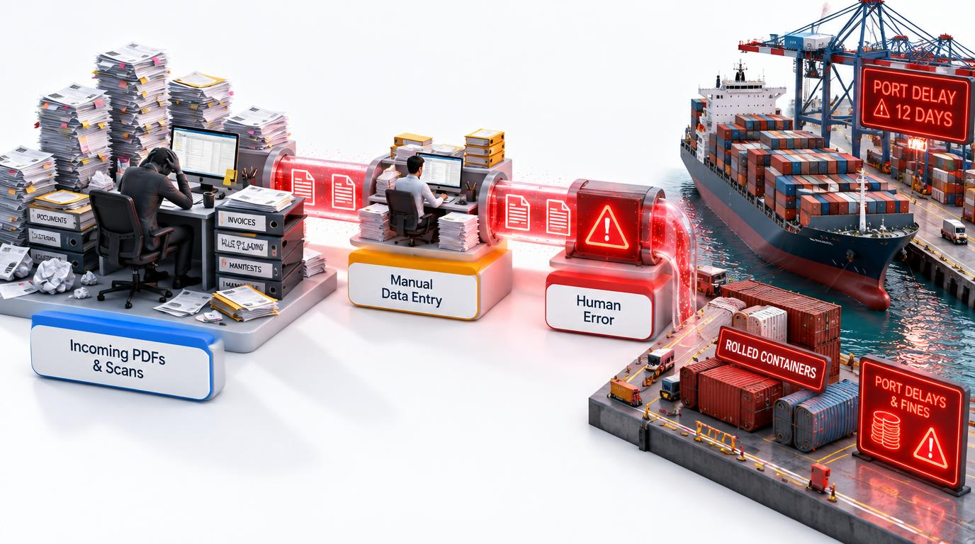
Key Operational Pain Points:
- The “Template” Trap: Traditional scanning software breaks whenever a foreign supplier changes an invoice format or layout, forcing teams back to manual typing.
- Hidden Mismatches: Discrepancies in piece counts, gross weights, or HS Codes across multi-document shipment packages are rarely caught until cargo arrives at customs, leading to costly holds and storage fees.
- Communication Friction: Customer service representatives waste hours scanning multi-page PDFs to answer simple client queries regarding free-time terms, agreed rates, or special handling instructions.
- Margin Erosion: Unplanned port detention and demurrage charges routinely wipe out profit margins on individual trade lanes.
The Solution: Next-Generation Document Intelligence (Document AI)
Rather than treating documents as static images stored in digital filing cabinets, the proposed solution introduces an Intelligent Document Layer that reads, understands, verifies, and interacts with every piece of paperwork flowing through the business.
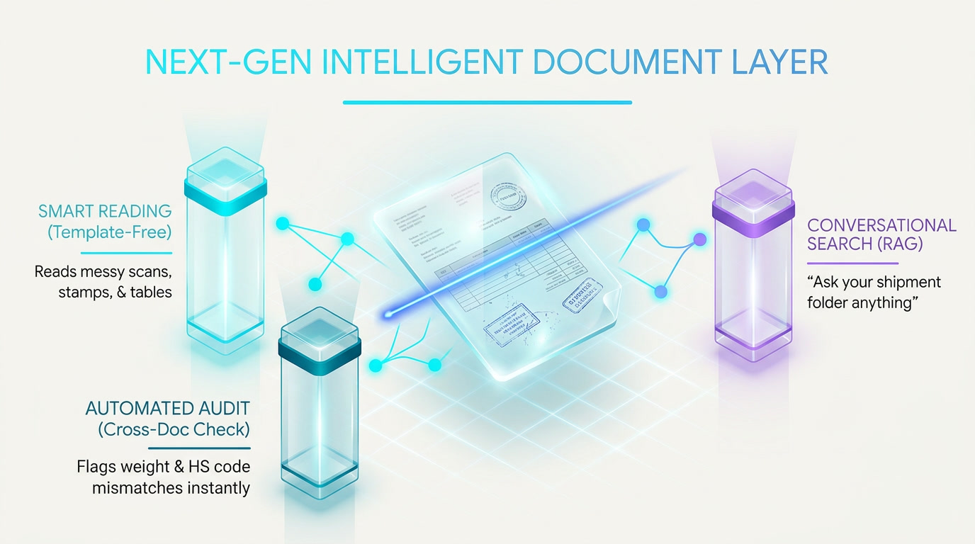
This Document AI system rests on three strategic technological pillars, explained non-technically below:
Key Business Benefits and Strategic Impact of Document AI
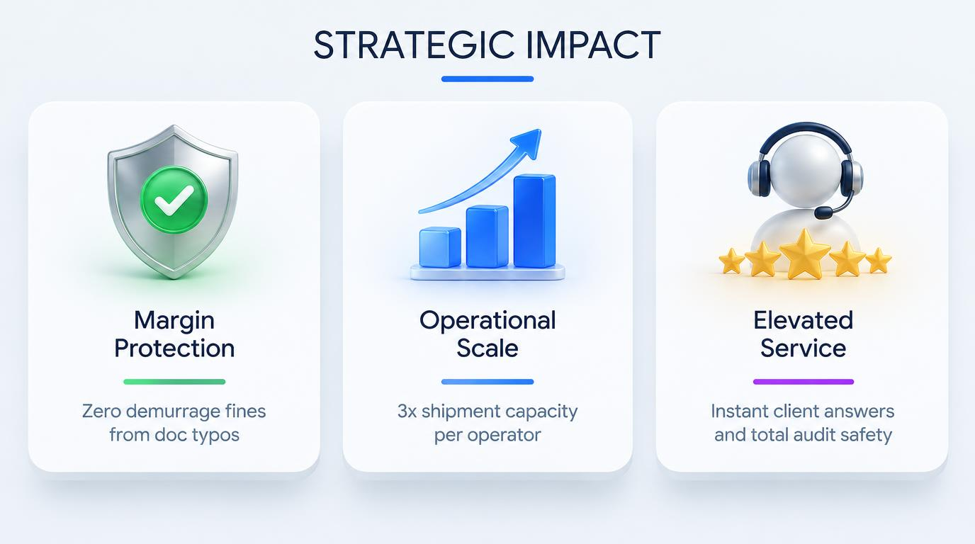
A. Direct Margin Protection
- Eliminate Avoidable Fees: By pre-auditing all documents prior to customs submission, forwarders eliminate demurrage, detention, and amendment fees caused by clerical errors.
- Freight Rate Verification: Automatically cross-reference vendor invoices against agreed carrier contract rates to catch overbilling.
B. Scalability Without Headcount Expansion
- 80% Reduction in Data Entry: Operators shift their time from manual typing and verification to high-value exception management and customer care.
- Higher Shipment Ratios: Single operators can manage up to three times more active files without an increase in stress or error rates.
C. Differentiated Customer Experience
- Instant Client Response: Customer support teams can immediately retrieve specific clauses, commercial details, or compliance certificates while on the phone with clients.
- Proactive Client Alerts: Automatically notify shippers of missing documentation days before vessel arrival rather than after a port hold occurs.
D. Audit Readiness & Compliance Safety
- Complete Digital Audit Trail: Every document, modification, and verification step is logged, ensuring complete compliance with global customs regulations and tax audits.
Implementation and Integration Strategy
A critical advantage of modern Document AI technology is its ability to layer directly over your existing infrastructure without disrupting ongoing operations.
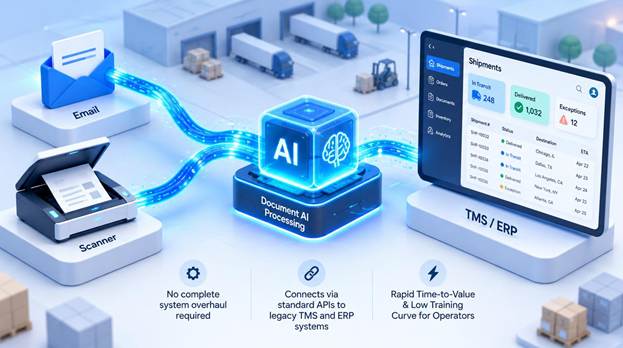
Zero Infrastructure Overhaul: The system connects seamlessly to your existing email inboxes, document repositories, and legacy Transportation Management Systems (TMS) via standard APIs.
- Rapid Time-to-Value: Because the system operates without the need to build custom templates for every foreign supplier, deployment can occur in weeks rather than months.
- Low Training Curve: Operators interact with the system using simple web interface tools and natural language prompts, requiring minimal technical training.
Conclusion and Recommendation
In today’s logistics landscape, operational efficiency and data accuracy are no longer back-office concerns—they are primary competitive differentiators.
Continuing to rely on manual document entry and fragmented file storage places an artificial ceiling on business growth while exposing profit margins to constant risk. Implementing a Next-Generation Document AI and Conversational Knowledge Platform provides immediate protection against operational delays, significantly lowers processing costs, and positions the business as a digitally advanced leader in global trade.
Recommended Next Step: Contact EACOMM Corporation and schedule a 30-day proof-of-concept (PoC) using a sample batch of historical shipment files (Invoices, Packing Lists, and BLs) to benchmark data extraction accuracy, discrepancy detection, and time savings against current manual baseline workflows.