20 things you need to know about the e-Gov Act IRR (Implementing Rules and Regulations)
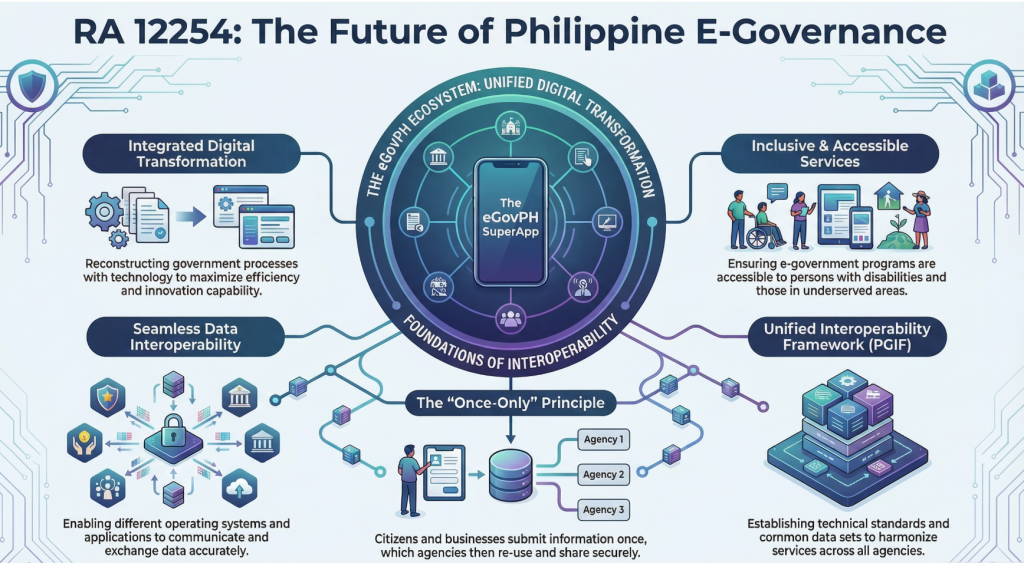
Republic Act No. 12254, officially known as the E-Governance Act, marks a monumental step toward the digital transformation of the Philippine bureaucracy. To operationalize this landmark legislation, the Department of Information and Communications Technology (DICT) has promulgated the “2026 Implementing Rules and Regulations of the E-Governance Act,” or e-Gov Act IRR which establishes the comprehensive framework needed to build a fully integrated, responsive, and secure online citizen-centered government. The IRR will officially take effect fifteen (15) days after its publication. 20 Things You Need to Know About the IRR of the E-Governance Act Whether you are a citizen, a public servant, or a business owner, this law will significantly change how you interact with the government. Here are the 20 most important things you need to know: 1. It covers almost the entire government. The rules apply to all executive, legislative, judicial, and constitutional offices, including local government units (LGUs), state universities and colleges (SUCs), and government-owned or -controlled corporations (GOCCs). 2. DICT takes the lead. The Department of Information and Communications Technology (DICT) is the primary implementing agency and administrator of the Act, responsible for overall policy leadership and ensuring that all national and local ICT projects are aligned. 3. A dedicated office for E-Government Projects will be established. The IRR mandates the creation of the E-Governance Unified Project Management Office (EGov UPMO). This bureau-level unit will oversee, monitor, and provide technical guidance on the execution of all government ICT projects. 4. Government agencies will be graded on compliance. The DICT will develop Performance Scorecards to measure how well government entities are complying with the E-Governance Act, including their interoperability, cybersecurity, and data privacy standards. 5. The E-Government Master Plan (EGMP) is the blueprint. The DICT will formulate the EGMP, which will serve as the sole and overarching national roadmap for the development and harmonization of all electronic government programs and digital services. It will be reviewed and updated at least every three years. 6. Say hello to the eGovPH SuperApp. Government entities with frontline services must integrate into the Citizen Frontline Delivery Services Platform (CFDSP), currently known as the eGovPH SuperApp. This ensures citizens have a unified digital platform to access, request, and track frontline transactions electronically. 7. LGUs must go digital. Within one year, the DICT and DILG will publish a Local Government Digital Service Standard (LGDSS). LGUs will be required to adopt the Electronic Local Government Unit (eLGU) System for services like business permits, tax payments, and civil registry requests. 8. Cashless government transactions via eGovPay. A Government Digital Payment System (“eGovPay”) will be created, allowing citizens and businesses to remit and receive payments electronically to or from government agencies using debit cards, credit cards, and mobile wallets. 9. Push for paperless approvals via PNPKI. To reduce red tape, the Philippine National PKI (PNPKI) will be promoted as the official system for issuing digital certificates. This will allow paperless transactions and remote approvals by authorized government signatories. 10. Automated government HR systems. A Human Capital Management Information System (HCMIS) will be developed to eliminate paper-based HR processes in the government. It will automate recruitment, payroll, leave management, and performance management for civil servants. 11. Real-time monitoring of government funds. To ensure fiscal discipline, an Integrated Financial Management Information System (IFMIS) will be deployed. This system will enable real-time, online accounting and monitoring of government obligations and disbursements. 12. An Online Public Service Portal for citizen feedback. The government will launch an Online Public Service Portal to act as a help desk. Integrated with systems like the 8888 Citizens’ Complaint Center, it will allow citizens to request information, report issues, and provide commendations. 13. A unified Philippine Digital Health System. In coordination with the Department of Health (DOH), a comprehensive and interoperable digital health system will be established to provide wide access to quality health information and services for every Filipino. 14. Systems must talk to each other. The Philippine Government Interoperability Framework (PGIF) will establish technical standards ensuring seamless operations and data sharing among various government agencies, breaking down isolated system silos. 15. Free public internet access is prioritized. The IRR reaffirms the commitment to provide free access to the internet for the public, utilizing the Free Public Internet Access Fund (FPIAF) to finance necessary computer systems and distribution networks. 16. Mandatory government website upgrades. All covered entities must set up and consistently enhance their websites and e-Bulletin Boards. These websites must be mobile-friendly, interactive, highly secure, and feature an integrated citizen feedback mechanism. 17. The “Once-Only” Principle. To save citizens time, the government will implement a “Once-Only” principle. This means that citizens and businesses will only need to submit certain information and documents once; government agencies must re-use and share this data internally rather than asking the public repeatedly. 18. Strict privacy impact assessments (PIA). Agencies must conduct a mandatory Privacy Impact Assessment (PIA) before processing personal data in proposed E-Government systems to identify, evaluate, and manage risks to citizens’ privacy. 19. Every agency needs a Chief Information Officer (CIO). The government will institutionalize the role of the CIO at a senior, executive level. The CIO will be the primary accountable official for an agency’s digital transformation, managing ICT projects, cybersecurity, and interoperability compliance. 20. The ICT Academy will upskill the workforce. To ensure that both government workers and citizens have the right digital skills, the DICT will establish the ICT Academy. It will serve as the National Center of Excellence for ICT Education, offering trainings, scholarships, and competency standards for government IT personnel. Implementation Timeline of the eGov Act IRR The full implementation of the E-Governance Act follows a phased approach, with the overarching mandate to complete the transition within one (1) year from the effectivity of the Act. To manage this, the Department of Information and Communications Technology (DICT) and other key agencies are required to issue a “transition master plan” and guidelines for the phased compliance of the Act within 90 days from the effectivity of the Implementing Rules and Regulations