Are you looking to level up your backend web development skills or preparing for the TESDA Web Development (Backend) NC III Certification? Whether you are a student, an aspiring developer, or a professional aiming to validate your backend expertise, having a structured, comprehensive study guide is the key to success.
We are excited to share a complete review guide previously used for a 10-day bootcamp tailored specifically for the TESDA Backend Web Development NC III assessment. This guide is designed to take you from foundational concepts to building and deploying functional backend systems.
What’s Inside the Backend Web Development Review Guide?
This comprehensive material covers everything from planning a project to deploying a secure, database-driven RESTful API. Here is a sneak peek at the core competencies you will master:
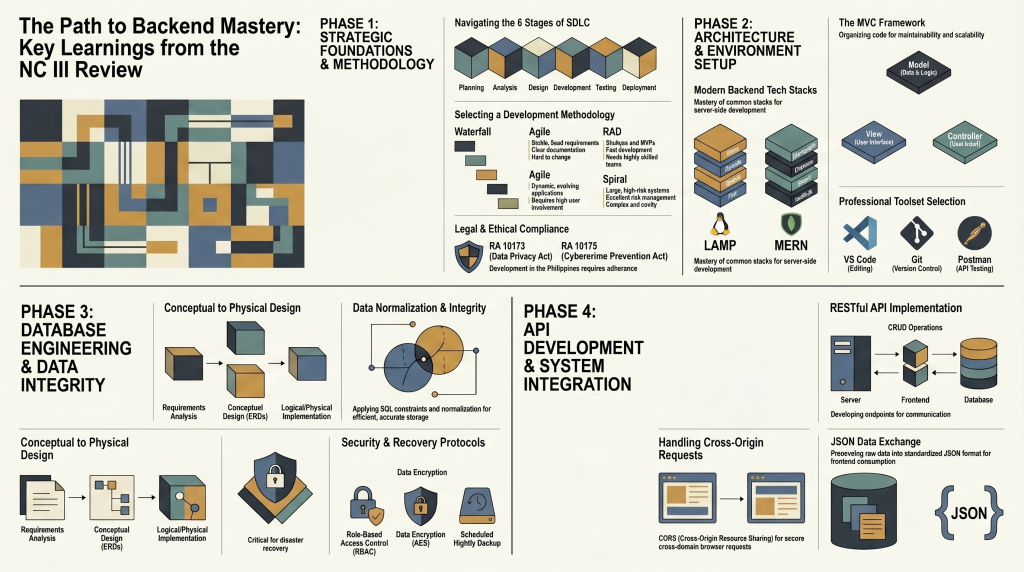
1. Software Development Methodologies & Project Planning Before writing a single line of code, a developer needs to understand how to plan. The guide breaks down the Software Development Life Cycle (SDLC) and compares industry-standard methodologies. You will learn exactly when to use Waterfall for stable projects, Rapid Application Development (RAD) for quick prototypes, Agile for dynamic platforms, and Spiral for high-risk enterprise systems.
2. Server Setup and Architecture Understanding where and how your code runs are critical. The guide explores different hosting types, including VPS, Dedicated, and Cloud hosting. It walks you through setting up popular development stacks like LAMP (Linux, Apache, MySQL, PHP), LEMP, MEAN, and MERN. Furthermore, it covers essential server security practices, such as enforcing HTTPS, configuring firewalls, and utilizing access control.
3. Database Design, Normalization, and SQL Data is the heart of any backend system. You will learn the best practices for designing databases using Entity-Relationship Diagrams (ERDs) to map out tables, attributes, and relationships. To ensure data integrity, the guide provides a step-by-step breakdown of database normalization, teaching you how to organize data from the First Normal Form (1NF) up to the Third Normal Form (3NF) to eliminate redundancies. Of course, you will also get hands-on practice with basic to advanced SQL CRUD operations and data aggregation.
4. The MVC Framework and RESTful APIs Modern backend development relies heavily on the Model-View-Controller (MVC) architectural pattern to keep code clean and scalable. The material introduces this concept alongside a deep dive into RESTful APIs. You will learn how to:
- Use standard HTTP methods (GET, POST, PUT, PATCH, DELETE) properly.
- Process data on the server-side, complete with input validation and error handling.
- Secure your APIs using methods like API Keys, Basic Auth, Bearer Tokens (JWT), and OAuth 2.0.
Hands-On, Practical Application
Theory is only half the battle. This guide requires you to put your knowledge to the test through rigorous exercises. You will build an ERD for a “CampusConnect” student portal, construct centralized API routers capable of handling user authentication, and even integrate third-party data by building a Manila Weather App using the Open-Meteo and Groq APIs.
Ready to Start Learning?
If you are serious about acing your TESDA institutional assessment and becoming a proficient backend developer, this resource is a goldmine. It bridges the gap between raw coding and professional software engineering principles.
Get ready to write cleaner code, design better databases, and build scalable systems!
Need extra help preparing for your assessment? EACOMM Corporation offers catered review and training sessions to significantly increase your chances of passing the TESDA NC3 Assessment. For more information on how we can help you or your team succeed, please contact us at sales@eacomm.com.