The digital governance landscape in the Philippines reached a watershed moment with the signing of Executive Order No. 131 on November 12, 2026. Titled “Adopting the Artificial Intelligence Governance Framework and Creating the National Artificial Intelligence Council,” this executive issuance transitions the country from high-level aspirational statements into an actionable, whole-of-government regulatory and operational posture.
For institutional leaders, chief information officers, public sector administrators, and enterprise technology providers, EO 131 introduces concrete mandates and operational frameworks. Below is an examination of Executive Order No. 131, analyzing its regulatory architecture, systemic impacts across the public and private spheres, technical opportunities, and strategic compliance pathways.
Summary of Executive Order No. 131
Executive Order No. 131 operationalizes the constitutional mandate to prioritize research, development, and technological innovation (Article XIV, Section 10) in alignment with Chapter 8 of the Philippine Development Plan 2023–2028. Building upon the National Artificial Intelligence Strategy for the Philippines (NAIS-PH) approved in May 2025 and the National Innovation Council (NIC) AI Governance Framework, the order establishes a comprehensive national apparatus for artificial intelligence adoption.
The order is built upon two core pillars:
1. The Four Interconnected Elements of the AI Governance Framework
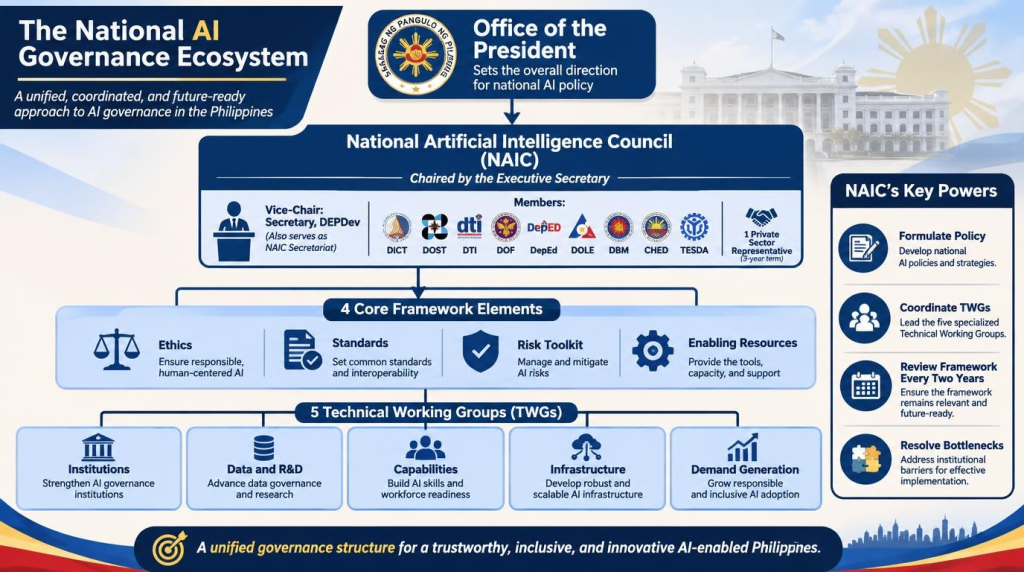
The framework establishes four structural elements to guide all AI development, deployment, and utilization:
- Ethics and Principles: Mandates transparency, explainability, safety, security, accountability, integrity, human centricity, fairness, equity, and sustainable development.
- Standards and Assurance: Establishes rigorous technical standards, testing, validation, conformity assessment, interoperability benchmarks, and assurance controls.
- Risk-Based Policy Toolkit: Adopts a proportional risk mitigation approach. Governance mechanisms must correspond to the context and severity of potential harm, utilizing sector-specific guidelines, algorithmic impact assessments, regulatory sandboxes, reviews of statutory rules, and coordinated grievance redressal.
- Enabling Resources: Directs systemic state investments toward institutional capacity, high-quality data pipelines, workforce development, digital infrastructure, and public-private demand generation.
2. Institutional Architecture: The National Artificial Intelligence Council (NAIC)
To prevent siloed governance, Section 2 creates the National Artificial Intelligence Council (NAIC), which reports directly to the President of the Philippines. The council is chaired by the Executive Secretary and vice-chaired by the Secretary of the Department of Economy, Planning, and Development (DEPDev), which also functions as the NAIC Secretariat. Council members encompass key Cabinet officials from the DICT, DOST, DTI, DOF, DepEd, DOLE, DBM, CHED, and TESDA, alongside one formalized private sector representative nominated by reputable business associations for a three-year term.
The NAIC is empowered to formulate policy, coordinate five specialized Technical Working Groups (Institutions, Data and R&D, Capabilities, Infrastructure, and Demand Generation), review the framework every two years, and resolve institutional bottlenecks.
Impact on Government IT Systems, Procurement, and Planning
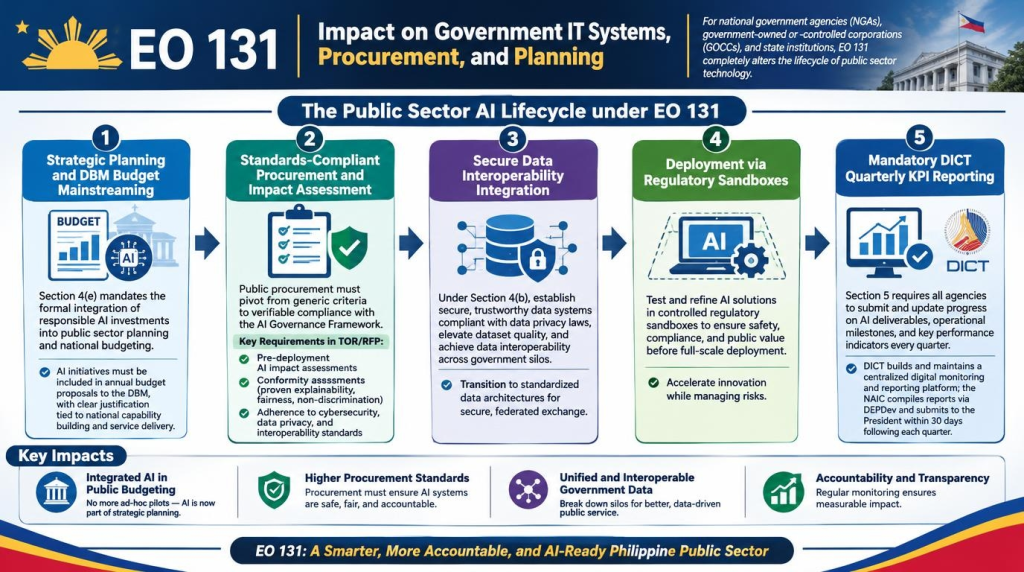
For national government agencies (NGAs), government-owned or -controlled corporations (GOCCs), and state institutions, EO 131 completely alters the lifecycle of public sector technology.
1. Mainstreaming AI into Public Budgeting and Planning
Section 4(e) directs the TWG on Demand Generation to formally integrate responsible AI investments into public sector planning and national budgeting processes. Government agencies can no longer treat AI as an ad-hoc or discretionary pilot project. AI initiatives must be integrated into annual budget proposals submitted to the Department of Budget and Management (DBM), with explicit justification tied to national capability building and service delivery.
2. Re-Engineering Procurement Specifications
Public procurement of digital systems must pivot from generic software criteria toward verifiable compliance with the AI Governance Framework. Government terms of reference (TOR) and requests for proposals (RFPs) will increasingly necessitate:
- Pre-deployment AI impact assessments.
- Conformity assessments demonstrating algorithmic explainability, fairness, and non-discrimination.
- Adherence to verifiable cybersecurity, data privacy, and interoperability standards.
3. Centralized Digital Monitoring and Reporting Mandate
Section 5 places an explicit compliance obligation on all government agencies. The Department of Information and Communications Technology (DICT) is mandated to build and maintain a centralized digital monitoring and reporting platform. Every concerned agency must submit and update progress on their AI deliverables, operational milestones, and key performance indicators on a strict quarterly basis. The NAIC compiles these reports through DEPDev and reports directly to the President within thirty days following the close of each quarter.
4. Shared Data Infrastructure and Interoperability
Under Section 4(b), the TWG on Data and Research and Development is tasked with establishing secure, trustworthy data systems compliant with data privacy laws, elevating dataset quality, and accelerating digital transformation to achieve data interoperability across disparate government silos. Agency systems must transition toward standardized data architectures capable of secure, federated exchange.
Impact on Business and the Private Sector in the Philippines
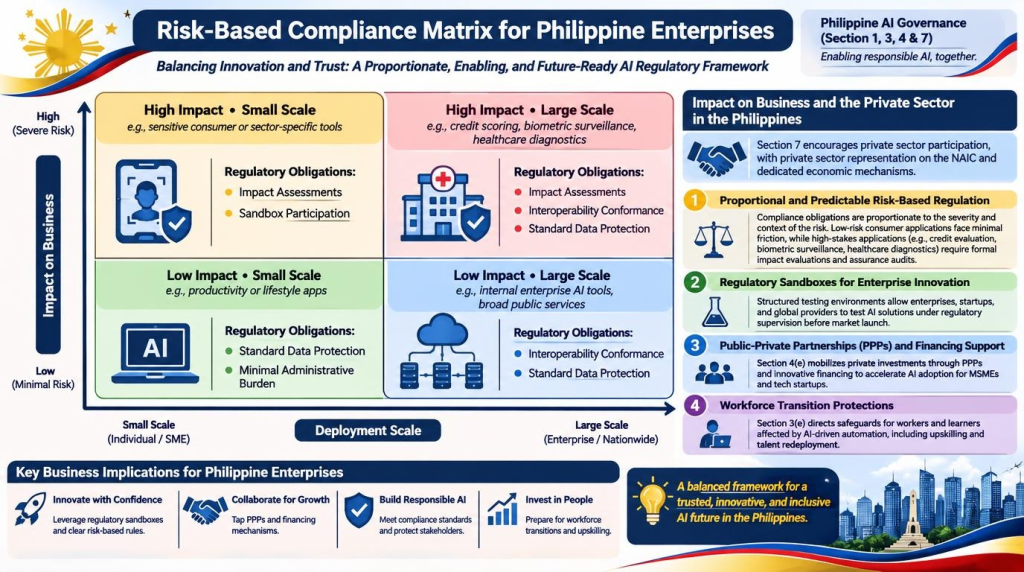
While Section 7 formally directs government bodies, it actively encourages private sector participation, reinforced by dedicated private sector representation on the NAIC and explicit economic mechanisms.
1. Proportional and Predictable Risk-Based Regulation
Rather than imposing rigid, punitive prohibitions, Section 1(c) institutes a risk-based policy toolkit. Businesses developing or deploying AI will face compliance obligations proportionate to the severity and context of the operational risk. Low-risk consumer applications will encounter minimal administrative friction, while high-stakes applications (such as credit evaluation, biometric surveillance, healthcare diagnostics, or critical infrastructure management) will require formal impact evaluations and assurance audits.
2. Regulatory Sandboxes for Enterprise Innovation
To safeguard commercial agility, the framework incorporates regulatory sandboxes. These structured testing environments permit domestic enterprises, startups, and multinational technology providers to test innovative AI solutions under regulatory supervision, validating compliance with national standards prior to widespread market commercialization.
3. Public-Private Partnerships (PPPs) and Financing Support
Section 4(e) mandates the mobilization of private sector investments via public-private partnerships, alongside innovative financing mechanisms to accelerate AI adoption across micro, small, and medium enterprises (MSMEs) and technology startups. This opens structured avenues for private systems integrators to co-develop public utility infrastructure.
4. Workforce Transition Protections
Section 3(e) charges the NAIC with recommending fiscal, policy, and legislative safeguards for workers and learners affected by AI-driven automation. Philippine enterprises, particularly in human capital-intensive sectors such as Business Process Outsourcing (BPO) and IT shared services, must anticipate evolving guidelines regarding workforce upskilling, talent redeployment, and ethical labor standards.
System Development and Technical Opportunities
EO 131 establishes an immediate demand for modern digital engineering, secure architectural design, and compliance-driven software products. Key development opportunities include:
- Algorithmic Auditing and Impact Assessment Platforms: The introduction of mandatory impact assessments creates a major market for automated software tools that evaluate models for bias, explainability, hallucination rates, and drift.
- Government-Grade Interoperability and API Gateways: With Section 4(b) emphasizing data interoperability across agencies, there is a clear demand for robust enterprise service buses, secure API management layers, and semantic data exchange frameworks.
- Privacy-Preserving Data Infrastructure: Compliance with Philippine data privacy laws within automated pipelines requires secure data registries, pseudonymization engines, synthetic data generation, and federated learning architectures.
- Mandatory DICT Quarterly Monitoring and Reporting Connectors: Agencies will require backend connectors and operational dashboards to aggregate and export performance indicators into the centralized DICT monitoring platform.
- High-Performance and Energy-Conscious Computing Solutions: Section 4(d) highlights the Philippines AI+ Infrastructure Masterplan 2026–2033, specifically noting the integration of energy and water requirements into national resource planning. This opens clear avenues for green data centers, edge computing architectures, and compute-efficient model deployment.
How EACOMM Can Assist Government Agencies and Private Enterprises
For over two decades, EACOMM Corporation has delivered bespoke software engineering, enterprise systems integration, and advanced technology consulting to government bodies and regional enterprises. As organizations face the technical and procedural requirements introduced by Executive Order No. 131, EACOMM provides the technical expertise and institutional experience necessary to achieve full compliance and operational maturity.
1. Public Sector System Architecture and Procurement Readiness
EACOMM assists government agencies in auditing existing digital infrastructure, drafting technical specifications aligned with NAIC standards, and designing secure, interoperable architectures. We ensure that digital transformation roadmaps meet DBM budgetary criteria and incorporate the ethical benchmarks mandated by Section 1.
2. Independent Algorithmic Audits and AI Impact Assessments (AI-IA)
Our engineering teams provide structured verification and validation services for proprietary and open-weight AI deployments. EACOMM helps organizations evaluate models for explainability, data lineage, security vulnerabilities, and demographic fairness, producing verifiable audit trails for regulatory compliance.
3. Interoperable Data Platforms and Secure Integrations
Leveraging decades of enterprise system development, EACOMM designs and deploys secure data exchange layers, custom API gateways, and data transformation pipelines. These systems facilitate secure inter-agency data sharing while rigorously preserving compliance with the Data Privacy Act and NAIC mandates.
4. Automated Compliance Monitoring and KPI Dashboards
To streamline compliance with Section 5, EACOMM builds custom middleware and reporting dashboards that automatically aggregate milestones, risk metrics, and project health indicators. These solutions simplify quarterly reporting to the DICT platform, eliminating manual overhead and ensuring data accuracy.
5. Custom Enterprise AI and Machine Learning Engineering
For private businesses seeking to leverage AI safely, EACOMM designs, builds, and maintains custom models and retrieval-augmented systems within secure corporate environments. By anchoring development in the risk-based guidelines of EO 131, we ensure our clients achieve commercial efficiency without running afoul of emerging regulatory benchmarks.
Conclusion
Executive Order No. 131 establishes that the future of technology in the Philippines belongs to transparent, accountable, and systematically governed innovation. Rather than an impediment, this framework provides institutional clarity for both public agencies and forward-looking enterprises. Organizations that proactively align their technical architectures with the national framework will build lasting digital trust and strategic advantage.
To learn more about how EACOMM Corporation can support your organization’s AI governance, system integration, and software development initiatives under EO 131, visit our technology solutions portal or contact our consulting team at https://eacomm.com/contact-us