Beyond the AI Gold Rush: How to Formalize AI Workflows in Enterprise Software Engineering
The initial wave of generative AI in software engineering felt a lot like a modern gold rush. Eager to bypass boilerplate and smash through bugs, developers quietly adopted an ad-hoc “Shadow AI” approach by copying proprietary code into browser windows and leaning on unvetted IDE extensions to boost their daily output. While this individual experimentation provided an undeniable hit of immediate productivity, it has left engineering organizations facing a chaotic reality. Without a formal structure, this Wild West of AI usage introduces massive data privacy risks, fragments the development toolchain, injects subtle technical debt, and leaves leadership utterly unable to measure actual business value.
To transform this chaotic experimentation into a sustainable competitive advantage, organizations must shift their perspective from viewing AI as an individual helper plugin to treating it as a core enterprise capability. Truly capturing the value of generative AI requires institutionalizing it by embedding governed, continuous AI workflows directly into every phase of the Software Development Life Cycle (SDLC), from initial architecture to CI/CD pipelines. By building the proper architectural guardrails, contextual training, and automated feedback loops, engineering leaders can transform AI from a fragmented distraction into a well-oiled machine.
Our latest whitepaper, “Integrating AI Workflows into Software Engineering,” outlines the strategic imperative of engineering workflow formalization.
Separating “Low-Hanging Fruit” from Complex Bottlenecks
To move beyond Shadow AI and fragmented productivity, organizations must categorize SDLC tasks by their automation readiness. Software development tasks vary wildly in their readiness for automation, meaning organizations must differentiate between low-hanging fruit and complex challenges. This categorization ensures AI acts as a force multiplier without introducing systemic risk.
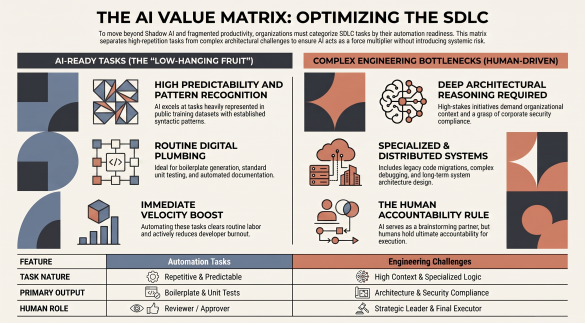
- AI-Ready Tasks (The Low-Hanging Fruit): The most AI-ready tasks in the software development life cycle are those that are highly repetitive, predictable, and heavily represented in public training datasets. Boilerplate code generation, standard unit testing, and documentation generation fall squarely into this category. Integrating AI at these early stages provides an immediate boost to developer velocity while clearing out the routine digital plumbing that frequently causes developer burnout.
- Complex Engineering Bottlenecks (Human-Driven): Conversely, tasks that require deep architectural reasoning, subtle organizational context, or highly specialized business logic remain significantly harder to integrate into automated workflows. Large-scale legacy code migrations, complex debugging across distributed systems, and system architecture designs cannot simply be handed over to an autonomous assistant. These high-stakes initiatives demand a holistic understanding of how different microservices interact, a firm grasp of corporate security compliance, and an awareness of long-term product goals. While AI can serve as a powerful brainstorming partner or a localized refactoring tool during these phases, the overarching strategy and final execution must remain strictly human-driven to avoid injecting catastrophic architectural defects into the system.
Building the Guardrails: Governance and Security
Moving AI from an experimental shortcut to an integrated corporate workflow requires strict operational boundaries. Without a robust governance framework, a software organization risks leaking proprietary algorithms, violating data compliance laws, and inadvertently introducing legally compromised code into production systems.
The primary concern for software engineering leadership when adopting generative AI is data telemetry. When developers use consumer-facing AI chat interfaces, their inputs are often ingested to train future iterations of the underlying model. This means proprietary source code, internal system architectures, and embedded API keys can potentially be exposed to external entities or competitors. To balance engineering innovation with corporate security, organizations must establish a rigorous evaluation framework for tool selection. Software development teams typically choose between three distinct deployment models depending on their risk tolerance and infrastructure capabilities:
- Public and Commercial SaaS: Solutions like IBM Bob, GitHub Copilot or Claude provide the fastest path to adoption and the most sophisticated developer features. For enterprise tiers, vendors usually guarantee that proprietary code will not be used for model training, though organizations remain dependent on external vendor uptime and policy updates.
- Private Cloud Deployments: For organizations with higher security requirements, hosting foundation models within an enterprise Virtual Private Cloud (VPC) offers a reliable middle ground. This setup ensures that all prompt data and codebase context remain strictly inside the corporate security perimeter while still leveraging powerful, cloud-scale computing power.
- Local Open-Source Models: Industries with extreme compliance mandates, such as defense, banking, or healthcare, increasingly deploy open-source models like the Llama series directly onto developer workstations or local air-gapped servers. This strategy completely eliminates external data transmission risks, though it requires substantial hardware investments and localized maintenance.
Technology leaders must formalize these boundaries by publishing a clear, living policy known as an Organizational AI Manifesto. Crucially, the manifesto must cement the golden rule of modern engineering: AI tools are merely assistants, and the human engineer holds ultimate accountability. If an AI assistant generates a subtle security vulnerability or logic error that passes into production, the blame rests entirely on the developer who reviewed and approved the pull request.
Shifting Culture: From Syntax Writers to Critical Reviewers
Deploying advanced enterprise tools is only part of the equation, because the ultimate success of an AI integration strategy hinges on the human beings using the technology. Shifting an entire engineering department from manual code generation to an AI-assisted workflow requires a deliberate focus on upskilling, psychological safety, and structured knowledge sharing.
As generative AI handles the bulk of raw syntax generation, the developer’s primary value shifts from writing code to evaluating, debugging, and validating it. To manage this cultural integration, technology leadership must navigate two opposing psychological extremes across their engineering teams: AI Anxiety and AI Complacency.
- Mitigating AI Anxiety: Some engineers view automation as a direct threat to their job security, leading to passive resistance, low tool adoption, and hidden workflows. Leadership must communicate transparently that AI is an absolute force multiplier designed to eliminate repetitive toil, allowing developers to focus on higher-level creative problem-solving and system design.
- Countering AI Complacency: On the other end of the spectrum, some developers develop uncritical faith in the technology. They copy and paste massive blocks of AI-generated code directly into repositories without line-by-line verification. This behavioral pattern introduces subtle bugs and architectural drift, making a culture of healthy skepticism essential so that developers treat AI tools as highly capable but fallible assistants.
To scale AI knowledge without creating unnecessary bureaucratic bottlenecks, organizations should adopt a federated model by establishing an AI Practice Community or engineering guild. This structure leverages embedded AI Champions distributed across different product teams who possess a natural enthusiasm for workflow automation and machine learning.
Future-Proofing the Stack via Model-Agnostic Architecture
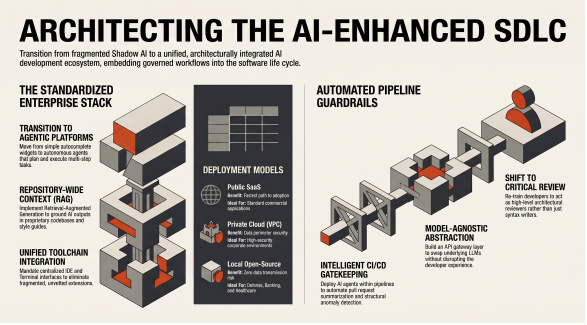
The landscape of artificial intelligence is highly volatile, with new foundational models frequently displacing market leaders in speed, cost, and accuracy. Hard-coding your entire engineering workflow into a single vendor’s API creates a dangerous single point of failure and severe technical debt. To future-proof the development lifecycle, organizations should build or adopt an abstraction layer between their internal tooling and the underlying large language models.
Key Takeaway: Treat your AI tooling like production software. Monitor its health through precise developer telemetry, optimize its inputs using active human feedback loops, and architect an abstraction layer that ensures your engineering organization remains model-agnostic.
Utilizing unified API gateways or open integration standards allows infrastructure teams to seamlessly swap out the underlying model behind the scenes. Whether upgrading to a newly released model or shifting a high-volume task to a cheaper open-source alternative, the developer’s front-facing IDE experience should remain entirely undisturbed.
Ready to move past individual experimentation and build a structured, scalable AI capability?
Contact EACOMM Corporation today to help your organization formalize your AI engineering strategy, enhance your developer velocity, and build a governed, future-proof software development lifecycle.