Generative Edge AI: The next frontier for AI Tech

Generative Edge AI’s Arrival An interesting crossroad is currently being crossed in Information Technology where computer, smartphone, and tablet hardware are becoming more and more powerful and at the same time, Generative AI algorithms, that previously needed multiple, powerful servers to run, are becoming more resource-efficient. Famously, China’s DeepSeek purportedly matches or even outshines OpenAI’s GPT models and was done at a fraction of the hardware resources. Already available are smaller versions of large language models (LLMs) that can be deployed on desktops, smartphones, and even single-board computers like Raspberry Pi. As these technologies improve, instead of having dependency on a cloud-based AI model, software applications will start having their own embedded generative AI models that will run independently of the cloud. This article will explore the potential that these solutions can provide. What is Edge AI? Edge AI refers to artificial intelligence models and algorithms that run on local devices rather than relying on cloud-based processing. This paradigm shift allows AI to function closer to the source of data generation, reducing latency, enhancing privacy, and improving real-time decision-making. Edge AI has been around for several years, with applications in various fields such as surveillance cameras with license plate recognition, AI-assisted driving, industrial automation, and healthcare wearables that analyze biometric signals in realtime. The core advantage of Edge AI is its ability to function independently of internet connectivity, making it suitable for critical applications that require low-latency responses and high reliability. Moreover, as hardware capabilities continue to improve, the scope of Edge AI applications is expanding, paving the way for a new frontier: Generative Edge AI. What is Generative Edge AI? Generative Edge AI is the integration of generative AI models with edge computing devices, enabling local devices to create content, synthesize information, and generate human-like text, images, code, or audio without the need for continuous cloud access. Unlike traditional Edge AI, which is primarily focused on inference and pattern recognition, Generative Edge AI brings creativity and contextual understanding to local devices. With advancements in model optimization techniques such as quantization, pruning, and knowledge distillation, modern generative models can now fit within the limited computational and memory constraints of edge devices. This evolution makes it feasible for smartphones, IoT devices, and embedded systems to generate complex outputs without relying on cloud-based models. Advantages and Uses of Generative Edge AI 1. Reduced Latency and Real-time Performance Since Generative Edge AI operates locally, it eliminates the delay associated with cloud-based AI processing. This is particularly useful for applications requiring immediate responses, such as voice assistants, augmented reality (AR) overlays, and AI-powered creative tools. 2. Enhanced Privacy and Security One of the biggest concerns with cloud-based AI solutions is data privacy. Generative Edge AI keeps sensitive data on local devices, minimizing the risk of data breaches, unauthorized access, and regulatory compliance issues. This is crucial for industries like government, healthcare, finance, and defense, where confidentiality is paramount. 3. Offline Functionality By removing dependence on an internet connection, Generative Edge AI ensures continuous operation even in remote areas or in cases of network disruptions. This makes it invaluable for field applications such as disaster response, military operations, and rural healthcare diagnostics. 4. Cost Efficiency Cloud-based AI incurs significant costs related to data transmission, cloud storage, and processing power. Generative Edge AI reduces these operational expenses by leveraging local processing, making AI-driven applications more affordable and sustainable. 5. Industry Applications Generative Edge AI has a wide array of use cases, including: Currently Available LLMs for Generative Edge AI Several open-source LLMs have been optimized for deployment on edge devices (often referred to as Small Language Models or SLMs), including: EACOMM’s Current Efforts in Generative Edge AI EACOMM is actively researching and developing solutions that integrate Generative Edge AI into business and industrial applications. We are developing prototypes and proof-of-concepts for custom-built Generative AI Assistants that can be deployed directly on desktop PCs, smartphones, or other edge devices. These assistants eliminate reliance on cloud infrastructure, ensuring seamless functionality even in environments with poor internet connectivity while significantly reducing security and privacy risks associated with transmitting sensitive data to external servers. A notable project currently in active development for an educational client is a Retrieval-Augmented Generation (RAG) system that seamlessly integrates enterprise-grade search engines with generative AI models. This system allows users to query internal databases and receive AI-generated responses enriched with contextual data, providing more accurate and relevant information. Designed to be hosted entirely on-premise, this solution runs efficiently on standard virtual machines without the need for GPUs and can even be installed on a standalone desktop PC. By keeping all operations within the local infrastructure, the system addresses key concerns related to data privacy, regulatory compliance, and unreliable internet access—critical factors for educational institutions handling sensitive student and faculty information. What the Future Holds As Generative Edge AI continues to evolve, we can expect groundbreaking developments that will redefine how we interact with technology. The proliferation of efficient AI chips and AI-ready computers and smartphones from the likes of Apple, Nvidia, and Qualcomm, coupled with further advancements in model optimization, will make generative AI a standard feature in personal devices. Future innovations could include: The potential of Generative Edge AI is vast, and as hardware and AI models continue to improve, we are on the brink of a new era where intelligent, creative, and autonomous AI solutions become an integral part of everyday life. EACOMM remains committed to pioneering this transformation, ensuring that businesses and consumers alike can harness the full power of Generative Edge AI.

Happy New Year! A Preview of Generative AI in 2024

As EACOMM bids farewell to another year and steps into the uncharted territory of 2024, it’s a perfect moment to reflect on the strides we’ve made in the realm of generative artificial intelligence (AI) and cast our gaze toward the exciting developments that lie ahead. The past year has been a testament to the incredible potential of AI, and 2024 promises to be a groundbreaking chapter in the evolution of generative AI technology. A Year of Achievements and Progress Before we delve into the future, let’s celebrate the milestones achieved in 2023. By using tools from Openai, Midjourney, Stability, IBM WatsonX, Google, and more, generative AI has continued to push the envelope of what is possible. From generating human-like text to aiding in creative endeavors, the applications have been vast and transformative. In 2023, we witnessed advancements in natural language processing, image generation, and even music composition, showcasing the versatility of generative AI. Businesses embraced AI-driven solutions to streamline processes, and creative professionals found new avenues for inspiration. Generative AI in 2024 1. Enhanced Understanding of Context: As we move into 2024, expect generative AI to demonstrate a deeper understanding of context. AI models will become more adept at grasping nuanced conversations, resulting in more accurate and contextually relevant responses. This development is poised to improve user experiences across various applications. 2. Ethical AI and Responsible Innovation: The ethical considerations surrounding AI will take center stage in 2024. There will be increased emphasis on responsible AI development, with a focus on minimizing biases and ensuring transparency. As the technology matures, the industry will continue to grapple with questions of ethics, privacy, and accountability. 3. Interdisciplinary Collaborations: The synergy between generative AI and other disciplines will become more pronounced in the coming year. Expect to see collaborations between AI researchers, artists, writers, and scientists, leading to innovative projects that blend creativity and technology in unprecedented ways. 4. Customizable AI Solutions: In 2024, we anticipate the emergence of more customizable AI solutions. Businesses and individuals will have the ability to tailor AI models to their specific needs, enabling a more personalized and efficient integration of generative AI into various workflows. 5. Advancements in Multimodal AI: The integration of multiple modalities—text, image, and possibly even audio—will be a key focus in 2024. This will open new possibilities for creative expression and problem-solving, as AI models gain the ability to understand and generate content across different formats. Embracing the Future with Optimism As we usher in the new year, let’s approach the future of generative AI with optimism and a commitment to responsible innovation. The potential for positive impact is immense, from revolutionizing industries to fostering new forms of artistic expression. EACOMM can help you embark on a journey into 2024, where the boundaries of what’s possible continue to expand, driven by the ever-evolving capabilities of generative artificial intelligence. EACOMM Corporation wishes you a Happy New Year filled with innovation, creativity, and the boundless possibilities of the AI-powered future!

EACOMM presents new AI technology at the 2023 Procurement Summit

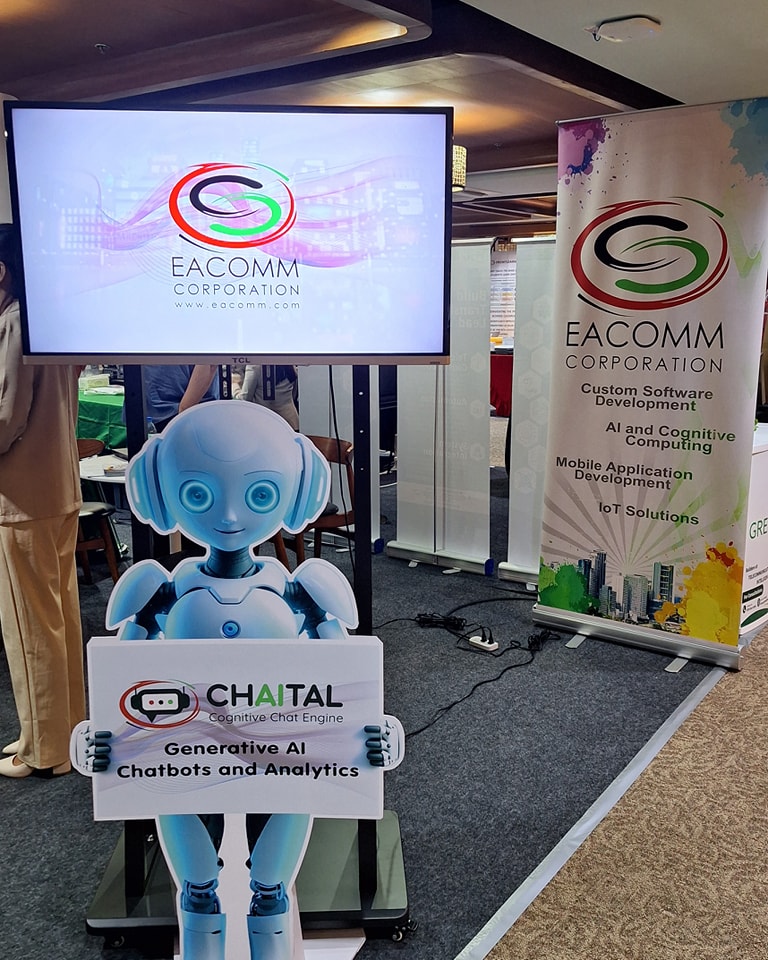
EACOMM Corporation, a leading Filipino-owned custom software developer specializing in AI technology, IoT, web, and mobile applications, was honored to be invited to participate at the recently concluded 2023 Philippine Procurement Summit, held on October 23–24, 2023, at the Philippine International Convention Center and organized by the Government Procurement Policy Board Technical Support Office (GPPB-TSO). The event revolved around the theme “Building a Cadre of Procurement Professionals as Catalysts for Innovation and Competitiveness.” The Philippine Procurement Summit is an annual event that serves as a platform for government procurement practitioners and suppliers to converge, exchange knowledge, and explore innovative strategies to transform the procurement landscape. The summit’s focus on building a cadre of procurement professionals reflects the desire to equip participants with the skills and insights needed to drive innovation and enhance competitiveness within their organizations. EACOMM Corporation seized this opportunity to demonstrate its expertise in the field of AI technology and its transformative potential for government services. Senior System Architect Karlo Martin Robosa delivered a presentation on various AI-related projects undertaken by EACOMM over the past decade, with an emphasis on generative AI use cases in the Philippines, particularly in government. During his presentation, Mr. Robosa shed light on EACOMM’s ongoing and past AI projects, including chatbots, analytics, machine learning, and IBM Watson integrations. The 2023 Procurement Summit was an enriching and inspiring event, and EACOMM Corporation is proud to have been part of this gathering of professionals who are committed to advancing the field of procurement. The summit demonstrated the transformative power of procurement in driving innovation and competitiveness, ultimately shaping the future of government operations and supplier relationships. Inquire now about how AI technology can be used for your business. EACOMM offers free consultations, demonstrations, and presentations to key stakeholders to better understand AI technology and how it can be used in both public and private organizations.

AI Development in the Philippines: Enhancing Public Services

The Philippine government has recently focused its efforts on the utilization of Information Technology to help improve the lives of its citizens. In the past decade, a dedicated Department of ICT was created to focus efforts on digitalization through a National ICT Development Agenda. Currently in the works is an E-Governance Law that has been tagged as urgent by the current regime. With AI development and machine learning becoming more accessible, it is time to seriously consider these technologies and the advantages they may provide for e-governance systems be they at the local or national level. Advantages of AI and ML for e-government systems AI and ML applications in e-governance systems There are several AI and ML applications that can be incorporated into e-government systems that can be advantageous to Philippine LGUs and National Agencies. Some examples include: AI Development challenges and considerations There are a variety of challenges and factors to consider when choosing to implement AI and ML in e-governance systems in the Philippines. Perhaps the main point to consider is the effect of AI and ML on personal privacy. The use of artificial intelligence and machine learning in e-government systems necessitates the collection and analysis of citizen data. Selecting which data is deemed ‘acceptable’ to process and analyze should be done with transparency and with the citizen’s explicit consent. The security of the storage of sensitive personal data should also be taken into account and as much care as possible must be taken to avoid such data going into the wrong hands. Secondly, in the Philippines, not all citizens have access to technology, which can hinder the efficacy of e-governance systems that rely on AI and ML. It is imperative that any system to be developed should take into account how citizens can access it and ensure that citizens will not be left behind simply because they cannot afford a smartphone or Internet access. Implementing AI and ML in e-governance systems can be expensive, necessitating substantial investments in technology and training. This is particularly true if AI/ML would be dependent on third-party technologies from other countries. It is essential to justify the implementation of these systems by demonstrating that their advantages outweigh their expenses and that internal/local expertise in AI/ML technologies be encouraged and nurtured to allow the country to compete globally without dependence on other countries. Private companies in the Philippines, are working diligently to develop AI and ML-powered products and services that can be integrated with e-governance systems securely and transparently to allow the Philippines to benefit from this groundbreaking technology. Conclusion The implementation of AI and ML in e-governance systems in the Philippines can provide citizens and the government with significant benefits. These technologies can improve service delivery and citizen engagement by automating processes, enhancing accuracy and transparency, and providing data insights. However, when implementing these technologies, obstacles such as data privacy, access to technology, skills, and expertise, and cost must be considered. Contact us today and find out how EACOMM Corporation can help you leverage the power of Artificial Intelligence and Machine Learning for your LGU or Government Agency or checkout the AI-powered products below:

Quick and Easy OpenAI GPT Chatbots on any Website

OpenAI GPT engines have revolutionized chatbots. The free-to-access ChatGPT is one of the fastest-growing websites in the history of the Internet. Integrating with OpenAI’s GPT engines via API, however, costs money and requires a bit of programming know-how. Integrating with GPT would require knowledge of PHP, Javascript, Python, or other web development languages. If you’re wondering how to have an AI Chatbot in your website or web application without programming, this tutorial will teach you how to use Chaital to embed ChatGPT functionality in your website by simply copy-pasting two lines of code! For a live example of this click on the chat button on the lower right of this web page that looks like this: Signing up to Chaital: OpenAI GPT Chatbot Engine Chaital is EACOMM’s implementation of an AI Chatbot using OpenAI GPT. To signup for Chaital, request for one-month free use by emailing: sales@eacomm.com. After your free first month, you can opt to use Chaital on an affordable monthly subscription. Creating your First Chatbot Once you’ve your account credentials, log in via https://eacomm.com/chaital/login. I built my first chatbot, what now? Build more chatbots! Chaital lets you build an unlimited number of chatbots from your one account. Build chatbots for multiple websites, mobile apps, back-office systems, etc. Need more complex AI-based systems? EACOMM can help you design and develop unique and innovative AI-powered systems for your business. Contact EACOMM Corporation at info@eacomm.com for more information.